Shuttle Conveyor with Tripper Conveyor
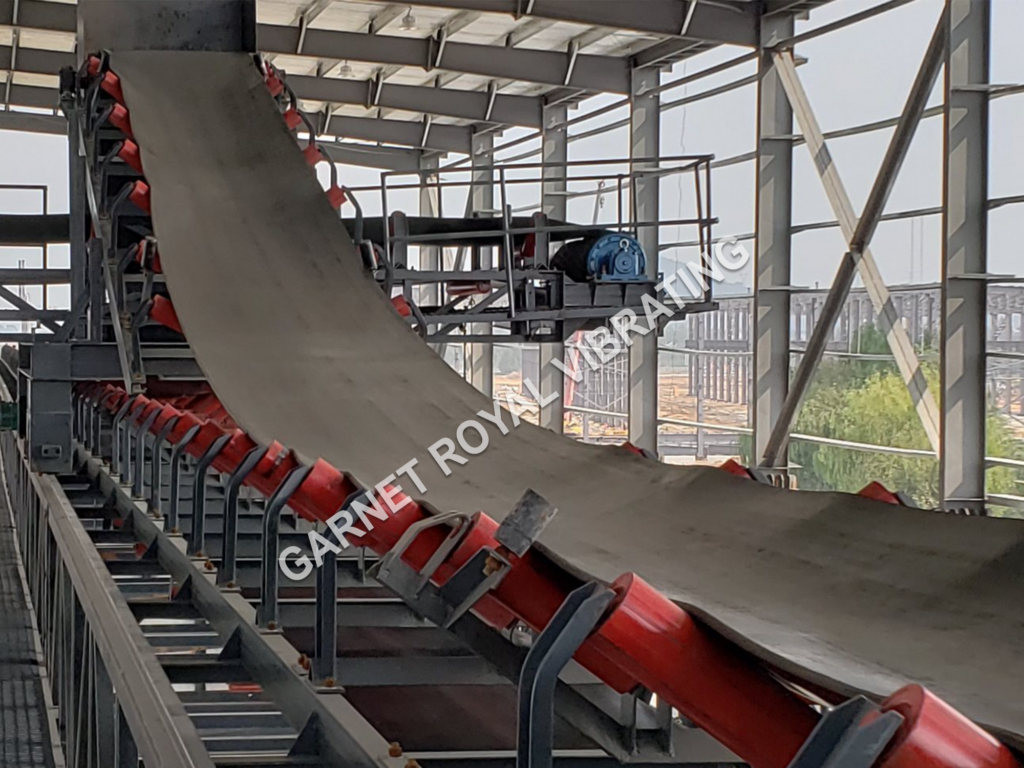
The Garnet Royal travelling conveyor solves one problem in two ways: getting material off a belt at more than one point along its run. Both arrangements are built on the same troughed beltline, and both are covered on this page because the choice between them is a layout decision rather than two separate purchases.
A tripper conveyor leaves the conveyor where it is and travels only on a carriage. The carriage lifts the belt over two bend pulleys and turns it back on itself, so the load is thrown off into a chute wherever the carriage happens to stand. It is the standard way to fill a long row of bunkers or to build a uniform longitudinal stockpile from a single conveyor line.
A shuttle conveyor moves bodily instead. The whole machine rides forward and back on rails, so material always leaves over the head pulley in the normal way and simply lands wherever the conveyor has been positioned. Where the number of discharge points is modest, it is the simpler, gentler, and lower-maintenance arrangement of the two.
How each arrangement works
Tripper conveyor
The tripper car is powered along rails laid on the conveyor frame and shuttles back and forth across the length of the run. As material is conveyed, it reaches the carriage, is lifted over the bend pulleys, and falls into the discharge hopper, allowing targeted unloading at any point along the belt. This is what makes the tripper the natural fit for large-scale operations where one incoming stream has to be distributed across many silos, bins, or bays, and it is why bunker rows of six, ten, or twenty cells are almost always served by a tripper rather than by anything else.
Shuttle conveyor
The shuttle is carried on rail-mounted bogies with end stops, limit switches, and travel interlocks and is fed either from a fixed hopper long enough to stay under the incoming stream across the full stroke or from a feed conveyor that travels in sympathy with it. Because the belt is never lifted or reversed, the discharge trajectory stays predictable, the chute work stays simple, and the belt sees far less wear—which matters most on coarse, lumpy, and abrasive material.
Diverter plough
Where a full travelling carriage is more than the duty requires, a diverter plough gives belt conveyors a mid-route unloading capability at a fraction of the cost. The plough is a non-terminal unloading device that diverts material from the main belt to an alternative route or storage area without stopping the conveyor system. It is a useful middle option in operations where material has to reach a small number of fixed points along the conveyor path, and it can be supplied alongside either arrangement above.
Technical specifications
| Product Type | Belt conveyor |
| Arrangements | Travelling tripper carriage · rail-mounted shuttle · diverter plough |
| Colour | Gray |
| Delivery Time | 45 Days |
| Main Domestic Market | All India |
| Material Handling | Coal, Briquette etc. |
| Minimum Order Quantity | 1 |
| Supply voltage | 400–420 Volts |
Specifications are indicative and configured to your application. Share your material, feed size and required output for an exact model recommendation.
Key features
Tripper arrangement
- Allows unloading at any desired location along the horizontal section of the belt conveyor.
- Distributes and unloads the same material into one or several specified storage bins.
- With a three-way hopper, discharges on one or both sides of the conveyor.
- Integrated into the conveyor line and sharing a single belt, so the arrangement stays simple and flexible to maintain.
- Enables comprehensive material distribution, maximizing the use of the site for material stacking.
- Simple design and straightforward operation over long bunker rows.
Shuttle arrangement
- Serves several bins, bays, or piles from one feed point.
- The reversible option doubles the area covered without extra equipment.
- No belt-lifting carriage, so less belt wear on lumpy, abrasive material.
- Lower transfer height and simpler chutework than a tripper arrangement.
- Normal head-pulley discharge keeps the trajectory predictable and easy to enclose.
- Rail-mounted bogies with end stops, limit switches, and travel interlocks.
- Festoon or cable-reel power feed with position indication to the control room.
- Fewer wear parts in the belt line, lowering routine maintenance.
Frequently asked questions
What is the difference between a tripper conveyor and a shuttle conveyor?
On a tripper the conveyor stays put and only a carriage travels, lifting the belt over bend pulleys to throw material off mid-run. On a shuttle the whole conveyor rides on rails and discharges normally over its own head pulley. A tripper suits long bunker rows; a shuttle suits a handful of bins and coarse, abrasive material.
Can a tripper be added to a conveyor we already run?
Often yes. The existing structure must accept the carriage load and the rails; there must be headroom for the belt to be lifted over the bend pulleys, and the take-up must have enough stroke to absorb belt length across the full travel. We survey the installation, check belt tension and structure, and quote the carriage, rails, and chute work accordingly.
What does the reversible option on a shuttle give me?
A reversible belt can run in either direction, so material fed at the center can be sent to bins on either side of the feed point. In effect, one machine covers twice the area, or a shorter rail run covers the same number of bins. It requires a reversible drive, dual-direction skirting, and scrapers arranged for both directions.
How is a shuttle conveyor fed while it travels?
Two arrangements are common. A fixed hopper long enough to stay under the incoming stream across the full stroke is the simpler option for short travels. For longer travels, the feed conveyor shuttles in sympathy with the machine so the transfer point stays aligned. The choice depends on the stroke, the tonnage, and the available headroom.
Can bin and bunker filling be automated?
Yes, with either arrangement. Level probes in each bin and position sensing on the rails let the carriage or the machine index to the next bin as each one fills and park when the row is complete. Manual and semi-automatic modes — where an operator selects a bin and the unit travels to it — are always retained for commissioning and maintenance, with travel interlocked against belt running and against the end limit switches.
How is dust controlled at the discharge?
On a tripper the belt reversal and the drop into the chute both generate airborne fines; a shuttle generates rather less, having only the one drop. We enclose the discharge head, fit skirted chutes with rubber sealing, keep the drop height as short as the layout allows, and provide flanged connections for extraction ducting or a traveling filter unit. Water or fog sprays are offered where the material tolerates moisture.